
When a nurse or doctor talks about a “stage” of a bedsore, they are describing how deep the injury goes into the skin and the tissue underneath. The scale most New York facilities use follows the National Pressure Injury Advisory Panel: Stages 1 through 4, plus two labels — unstageable and deep tissue pressure injury — for wounds whose depth is harder to see at first.
A stage is a medical description. It is not a verdict on the nursing home or hospital, and it is not something you have to diagnose yourself. If someone you love has a new red patch, a blister, or an open sore after a stay in care, get them evaluated. Then call Sinel & Olesen at 212-465-1000. We read the chart — turning logs, wound notes, care plans — and tell you what the records actually show.
What families usually notice first
Families rarely open a textbook. They notice a change on a heel, the tailbone, a hip, an ankle, or the back of the head: color that doesn’t fade after the person is moved; skin that feels warmer, cooler, or firmer than the skin around it; a blister; drainage on the sheets; or staff using words like “pressure injury,” “decubitus,” or “bedsore.” Those signs are enough to ask questions. You do not need a Stage 3 or Stage 4 label before you ask for the chart.
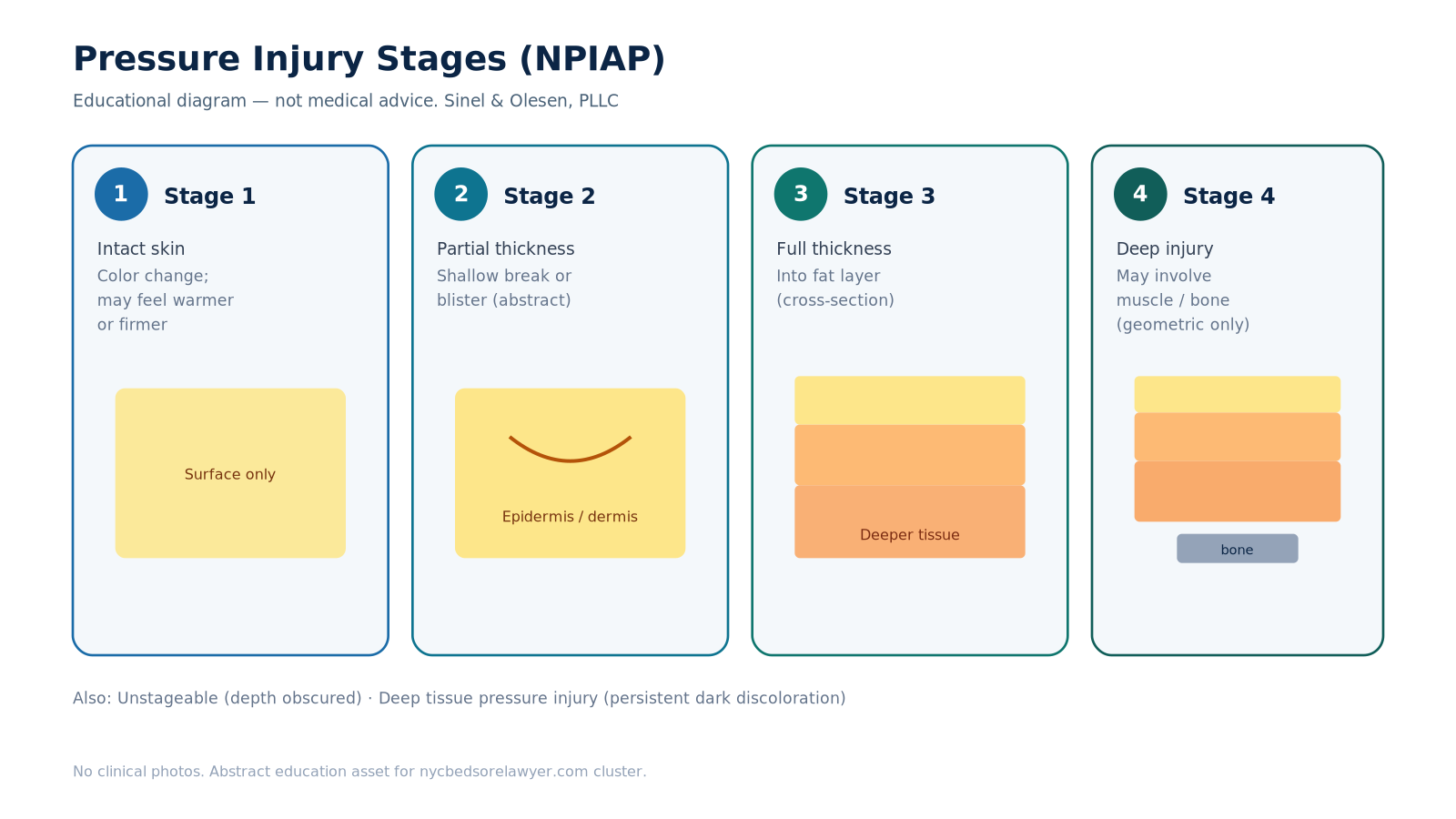
Stages 1–4 of a pressure injury (NPIAP). Educational only — not medical advice.
Stage 1: redness that stays
The skin is still closed. The area stays red when you press it (non-blanching). It may feel warm, firm, or slightly swollen. On darker skin tones the first warning is often a purple, ashy, or darker patch rather than bright red — which is why Stage 1 gets missed. This is the moment when repositioning, a better mattress or cushion, and close watching can still change the outcome. If staff wrote Stage 1 in the chart and then did nothing — or never noticed the change at all — that gap belongs in the records review.
Stage 2: a break in the skin, or a blister
The top layers of skin are broken. The wound may look like a shallow open sore with a pink or red base, or like a blister. Fat, muscle, and bone are not visible. Stage 2 means pressure or shear has already done more than irritate the surface. The person needs a wound-care plan and a turning schedule that is actually followed, not just written. This is also when families should request the medical records in writing — chart, care plan, wound logs, and turning logs — while the paper trail is still fresh.
Stage 3: the wound is deeper
The injury goes through the full thickness of the skin. Fat may show. Bone, tendon, and muscle do not. The wound can tunnel under the edges. These injuries take longer to heal and carry a higher risk of infection. Families often hear “bedsore” for the first time at Stage 3, even though the problem usually started days or weeks earlier as a Stage 1 or 2 that was not caught or not treated.
Stage 4: the deepest stage on the scale
Damage reaches through skin and fat. Muscle, tendon, or bone may be visible. Complications can include bone infection (osteomyelitis) and bloodstream infection (sepsis). Stage 4 is the deepest label on the NPIAP scale. It does not, by itself, prove a lawsuit. It does mean the injury is severe, and it is a reason to have a New York bedsore lawyer review the care plan, the turning logs, and every wound note in the file.
Unstageable: the base of the wound is hidden
When dead tissue (slough or eschar) covers the base of the wound, clinicians cannot see the depth. They call that unstageable. After the covering is removed, the wound is usually staged as Stage 3 or Stage 4. “We can’t stage it yet” is a clinical sentence. It is not a reason to wait on records or a legal consult.
Deep tissue pressure injury
A deep tissue pressure injury can look like a lasting deep red, maroon, or purple area. The skin may still be closed, or there may be a blood-filled blister. The damage is underneath. On darker skin, those color shifts are easy to miss if nobody is looking carefully. This is a standard NPIAP category — not a fifth “stage” in the 1–4 count. Treat it as serious and ask what staff did the first time the color change appeared.
Stage is not the same as neglect
Not every bedsore means someone was neglected. Some are clinically hard to prevent even with good care. New York nursing homes still owe residents a duty under 10 NYCRR 415.12(c): a resident who arrives without pressure sores should not develop them unless the clinical condition shows they were unavoidable despite reasonable efforts — and a resident who has them must get treatment aimed at healing and at preventing infection and new sores. The pattern we see across hospitals and nursing homes is familiar: missed turning, missed skin checks, moisture left too long, poor nutrition or hydration. The building and the legal theory can differ. What does not change is the need for the chart.
When to get the records
Do not wait for a late-stage label. As soon as you see a persistent red area or an open wound — or as soon as staff name a pressure injury — ask for the chart, the care plan, wound logs, and turning logs. Keep any photos your family already has. Do not start photographing wounds for this process. New York filing windows are short. Which clock applies depends on the facts. Call 212-465-1000 with the dates rather than guessing which statute controls.
Talk to a New York City bedsore lawyer
Sinel & Olesen, PLLC — NYC Bedsore Lawyer — represents New York families when a loved one developed bedsores in a hospital or nursing home. The consultation is free. If we take the case, you do not pay a fee unless we recover money for you. Call 212-465-1000, email info@sinellaw.com, or complete an online case evaluation. Office: 330 7th Avenue, 10th Floor, New York, NY 10001.